
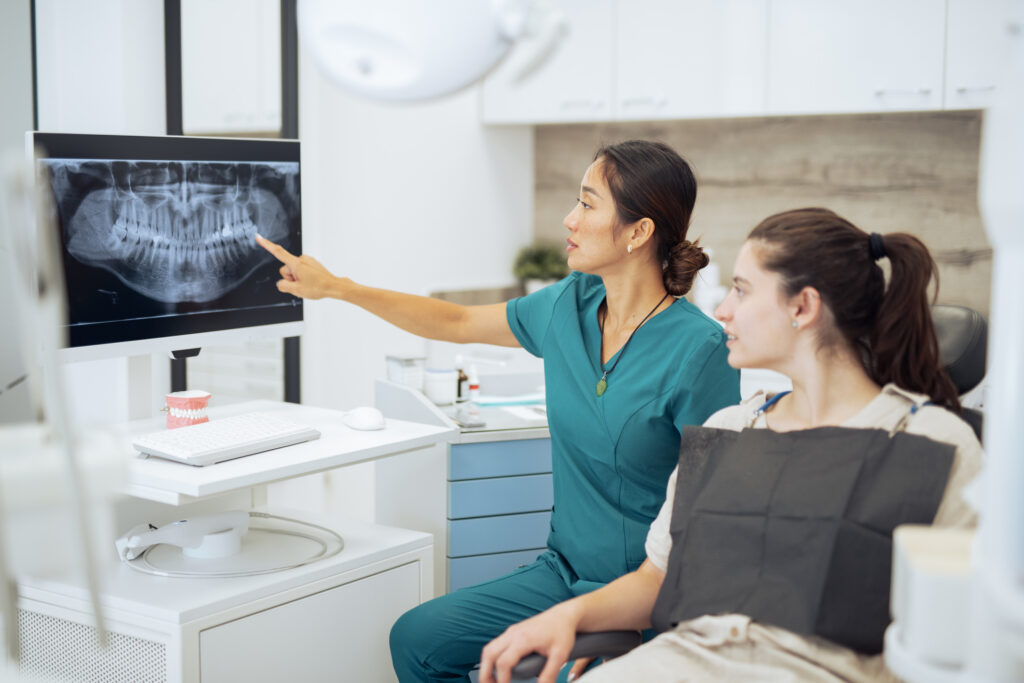
A dentist can tell a lot from looking directly at your teeth — but not everything. Some of the most significant dental problems develop where they can’t be seen: between teeth, beneath existing restorations, below the gumline, and inside the jaw itself. For Los Feliz patients who want a truly thorough picture of their oral health, dental X-rays aren’t an optional add-on. They’re an essential diagnostic tool. At California Dental Group, X-rays are a routine part of comprehensive care for this exact reason.
Why X-Rays Are Part of Routine Dental Care
The surfaces of your teeth that a dentist can visually examine represent only part of the story. Cavities frequently begin between teeth, in areas where enamel makes contact — spots that are completely hidden from view and unreachable by even careful probing. Without an X-ray, these cavities go undetected until they’ve grown large enough to cause symptoms or structural damage.
X-rays also allow dentists to evaluate the health of the bone supporting your teeth, check for infections, assess the status of unerupted or impacted teeth, and examine the roots and surrounding structures in ways that simply aren’t possible during a visual exam.
What Different Types of X-Rays Show
Not all dental X-rays are the same. Bitewing X-rays are the ones most patients recognize — small images taken of the back teeth that show the crowns and areas between teeth, making them particularly effective at catching early cavities and monitoring for bone loss between the teeth.
Periapical X-rays show the full length of one or more teeth, including the root and surrounding bone. These are especially useful for evaluating infections, abscesses, and the effects of gum disease. Panoramic X-rays capture the entire mouth in a single image and are commonly used to assess wisdom teeth, jaw structure, and overall dental development.
X-Rays for Los Feliz Patients: How Often Is Appropriate?
The frequency of X-rays depends on individual risk factors. Patients with a history of cavities, gum disease, or complex dental work may need images more frequently than someone with consistently healthy teeth. For most adults, bitewing X-rays are typically recommended once a year, while a full set or panoramic image may be taken every few years as part of a comprehensive assessment.
Digital X-rays, which are standard at California Dental Group, use significantly less radiation than older film-based systems — making routine imaging both safe and informative.
What Happens When a Problem Is Found
The value of X-ray-based detection is in timing. When a cavity is caught between appointments — before it causes pain or sensitivity — treatment is simpler and less invasive. An infection identified before it spreads can often be resolved with root canal therapy rather than extraction. Bone loss detected early gives patients more options for managing and stabilizing gum disease.
Waiting for symptoms to appear before investigating means waiting for problems to worsen.
Schedule Your Comprehensive Exam at California Dental Group
If you’ve been putting off a dental visit or haven’t had updated X-rays in a while, the team at California Dental Group is ready to help you get a clear picture of your oral health. Call 800-407-0161 to schedule your appointment and find out what’s going on beneath the surface.
